- From
- Jane Doe
- Date
- Subject
[posts] Hello, Mimeo
- Tags
- Hugo, Themes
- Series
- Building Mimeo
- X-Read-Time
- 2 min
- X-Plain-Text
- /mimeo/posts/2026/11/15/hello-mimeo.txt
What this is
Mimeo renders a Hugo site the way a .patch file or a mailing-list archive
looks: a header block, then the body, in a monospaced column that never
grows past eighty characters. It is still HTML, because links and images are
worth having, but nothing else was kept.
What you get
- A
From:/Date:/Subject:header on every page, generated from frontmatter. - Headings that keep their
##markers, lists that keep their asterisks. - Light and dark from the system preference, with CSS
light-dark()and no JavaScript at all. - A plain-text twin of every page at the same URL with
.txton the end: this one.
Some inline code: hugo server -D. Some bold and some emphasis.
A blockquote reads like a quoted reply. It can run to several lines and the gutter stays with it the whole way down.
A code block
| |
The colours are GitHub’s light and dark palettes, generated by Hugo and
switched with light-dark(). Without line numbers, the Hugo default:
hugo server -D # drafts too
A table
| Key | Value |
|---|---|
| Font | JetBrains Mono, else system |
| Width | 80 columns |
| Scripts | none |
An image
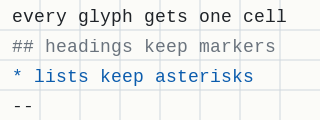
A raster image wider than the column is resized to it and served as WebP.
Its alt text has a \ in it on purpose, and the small inline one that
follows carries a
title with quotes, to show that both survive the trip into an attribute:
- Ordered lists keep their numbers.
- Nested lists indent two columns.
- like this
- and this