Disclosure: This analysis was researched and written with the assistance of Claude Code, Anthropic’s AI coding assistant. All candidate information was sourced from public reporting, campaign websites, editorial board interviews, and polling data. The persuasion scoring reflects the author’s editorial judgment applied through an AI-assisted workflow. Voters should verify claims independently before casting a ballot.
I just finished scoring every candidate in every contested race on both the Republican and Democratic primary ballots for Dallas County. Same methodology for both: two independent 1–10 scales measuring how much each candidate relies on facts/data versus feelings/emotions.
Now that both ballots are done, patterns jump out. The two primaries are operating in different universes — different emotional registers, different power dynamics, different relationships with money. Here’s what I found.
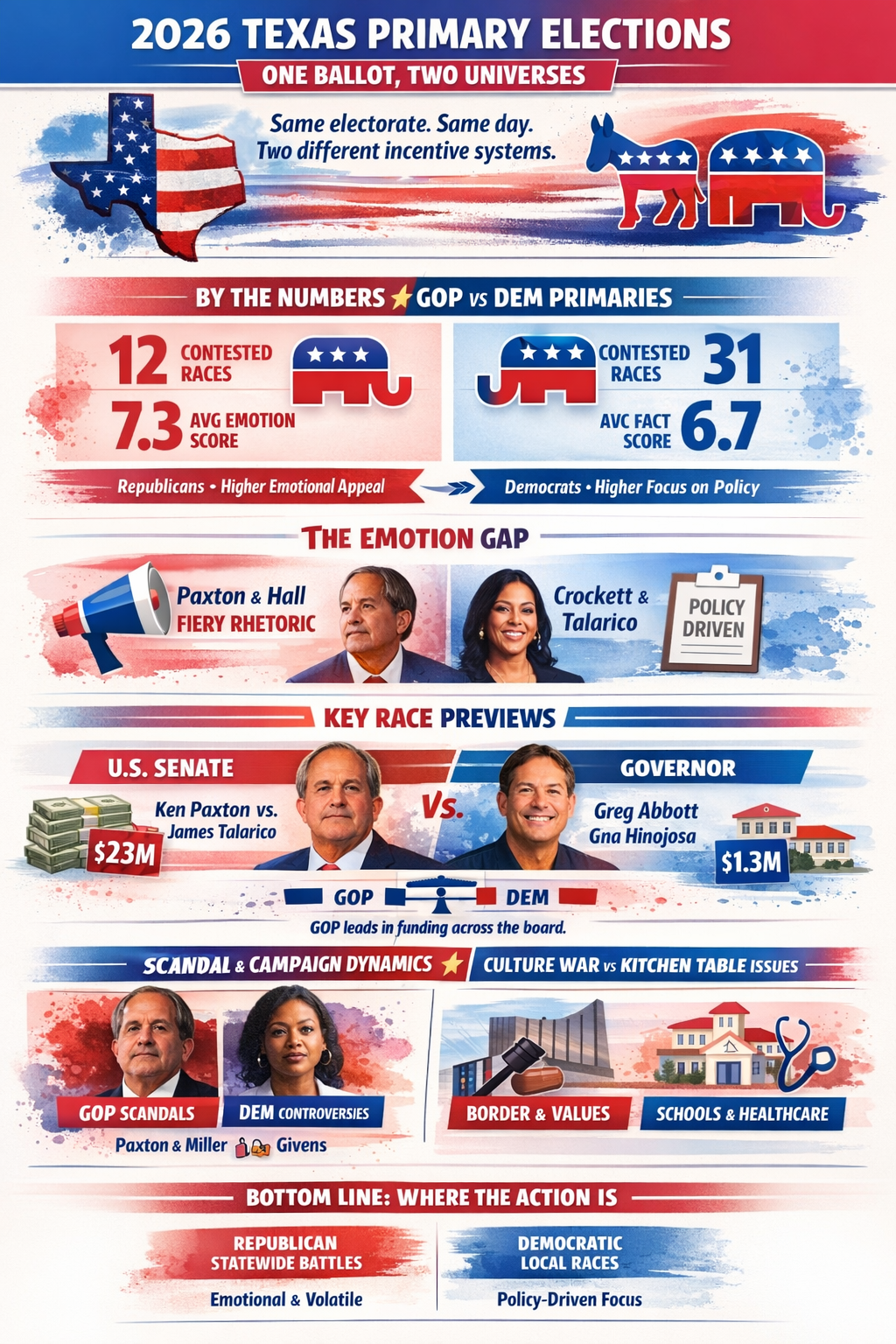
By the Numbers
| Republican | Democratic | |
|---|---|---|
| Contested races | 12 | 31 |
| Total candidates scored | 47 | 75+ |
| Highest fact score | 8 (Fox, Balido, Messinger, Button) | 7 (Talarico, Hinojosa, Johnson, Eckhardt) |
| Highest emotion score | 9 (Paxton, Hall, French) | 7 (Crockett) |
| Highest net-fact | +6 (Fox, Balido, Messinger) | +4 (Eckhardt, Goodman) |
| Highest net-emotion | +7 (Hall, French) | +2 (Crockett, Box) |
| Avg fact score (statewide frontrunners) | 5.0 | 6.7 |
| Avg emotion score (statewide frontrunners) | 7.3 | 5.0 |
The gap is stark. Republican frontrunners average 5.0 on facts and 7.3 on emotion. Democratic frontrunners average 6.7 on facts and 5.0 on emotion. The Republican primary rewards heat. The Democratic primary — at least this cycle — rewards policy specifics.
The Emotion Gap
The single biggest difference between these two ballots is the emotional ceiling. The Republican primary has three candidates scoring 9 on emotion — Ken Paxton (“take a sledgehammer to the D.C. establishment”), Bob Hall (Sharia law as the #1 threat to Texas), and Bo French (DEI fears at a railroad commission). Eight Republicans score 7 or higher on emotion.
The Democratic primary tops out at 7 — Jasmine Crockett’s “battle-tested fighter” branding. Only four Democrats score 6 or higher on emotion.
This isn’t because Democrats don’t have feelings. It’s because the two primaries reward different things. The Republican primary has a clear pattern: the more emotionally charged the campaign, the higher the poll numbers. Paxton (Emotion: 9) leads the Senate race. Abbott (7) and Huffines (8) lead their races. The lone exception is Chip Roy, the AG frontrunner at 7/5 — and even he is being chased by Mayes Middleton at 4/8.
The Democratic primary pattern is nearly inverted: the more policy-specific the campaign, the higher the poll numbers. Talarico (Facts: 7) has the dominant fundraising operation. Hinojosa (7) has a 30-point primary lead. Nathan Johnson (7) leads the AG race. Sarah Eckhardt (7) is the Comptroller frontrunner.
Both primaries have one thing in common: judicial candidates are restrained across the board, scoring low on emotion regardless of party. If you want fact-driven campaigns, look at the judges.
Race by Race: The November Preview
Every statewide primary winner on March 3 becomes a general election candidate on November 3. Here’s how the matchups are shaping up.
US Senate
| Republican | Democratic | |
|---|---|---|
| Frontrunner | Ken Paxton (Facts: 3, Emotion: 9) | Jasmine Crockett (5/7) or James Talarico (7/6) |
| Fundraising leader | John Cornyn — $10M raised + $50M satellite | James Talarico — $20M+ (98% small-dollar) |
| Polling leader | Paxton 38%, Cornyn 31% | Crockett 47% / Talarico 47% (split polls) |
| Primary dynamic | Insurgent vs. incumbent | Colleague vs. colleague |
This could produce the wildest general election contrast in the country. Paxton — impeached, indicted, running on pure MAGA emotional energy — versus either Talarico (a former schoolteacher running on small-dollar populism and policy specifics) or Crockett (a viral congresswoman running on combative progressive identity). Either matchup would be a cultural Rorschach test for Texas.
The money story is fascinating. Cornyn has $50 million in satellite support. Talarico built a $20 million operation from $25 donations. Crockett has $6.5 million and has spent almost none of it on ads. Paxton has $5.3 million and a MAGA brand that functions as free advertising.
Governor
| Republican | Democratic | |
|---|---|---|
| Frontrunner | Greg Abbott (Facts: 5, Emotion: 7) | Gina Hinojosa (7/6) |
| Cash on hand | $23M+ (Abbott) | $1.3M (Hinojosa) |
| Primary field | 11 candidates, none competitive | 9 candidates, none competitive |
| General election polling | Abbott 49%, Hinojosa 42% |
Both are essentially uncontested primaries — Abbott and Hinojosa each lead by 30+ points. But the general election preview is revealing. Abbott runs on emotional spectacle (razor wire, migrant buses, Operation Lone Star) backed by economic data. Hinojosa runs on education policy specifics ($10,000 teacher pay gap, the “Greg Abbott corruption tax”) backed by working-family empowerment narratives. Abbott’s $23 million dwarfs Hinojosa’s $1.3 million by a factor of 18. The 49–42 general election polling is closer than the money gap suggests.
Attorney General
| Republican | Democratic | |
|---|---|---|
| Frontrunner | Chip Roy (Facts: 7, Emotion: 5) | Nathan Johnson (7/4) |
| Primary dynamic | Four-way open-seat brawl | Three-way, mostly settled |
| Key tension | Policy nuance vs. MAGA purity | Electability vs. integrity |
This is the race where the two parties’ fact-driven candidates align. Roy and Johnson are both substantive, policy-focused legislators who emphasize institutional competence over partisan warfare. Roy is willing to disagree with Trump. Johnson wants to “minimize partisanship for the sake of productivity.” A Roy–Johnson general election would be the most policy-rich statewide matchup Texas has seen in years.
But Roy still has to get past Mayes Middleton (Emotion: 8), who’s running as the “MAGA candidate” with culture war trophies (Save Women’s Sports Act, Ten Commandments in classrooms). And Johnson’s 40% of primary voters are still undecided.
Lieutenant Governor
| Republican | Democratic | |
|---|---|---|
| Frontrunner | Dan Patrick (Facts: 6, Emotion: 7) | Vikki Goodwin (6/4) |
| Cash on hand | $38M (Patrick) | $161K (Goodwin) |
The most lopsided general election matchup in terms of resources. Patrick’s $38 million war chest is nearly 240 times Goodwin’s $161,000. Patrick is also the more emotionally skilled campaigner — a former radio host who knows how to work the “I fought for you” register while citing his $18 billion property tax cut. Goodwin runs competence-first. She’ll need money she doesn’t have to make that case statewide.
Comptroller
| Republican | Democratic | |
|---|---|---|
| Frontrunner | Don Huffines (Facts: 4, Emotion: 8) | Sarah Eckhardt (7/3) |
| Fundraising | $15M+ (Huffines) | Not reported (Eckhardt) |
| Campaign vibe | “DOGE Texas” branding | “Watchdog, not lapdog” |
The comptroller race is the purest distillation of the two primaries’ value systems. Huffines is running on vibes — “DOGE-ing Texas” with endorsements from Ted Cruz, Vivek Ramaswamy, Matt Gaetz, and Charlie Kirk. The concept is more brand than policy. Eckhardt is running on prosecutorial and county budget experience, institutional transparency, and anti-voucher oversight. One is selling feeling. The other is selling competence. If both win their primaries, the general election will be a clean test of which approach Texas voters prefer for a bean-counting office.
The Money Chasm
Here’s the financial picture across the marquee races:
| Race | GOP Leader | GOP $ | Dem Leader | Dem $ | Ratio |
|---|---|---|---|---|---|
| US Senate | Cornyn | $10M + $50M satellite | Talarico | $20M | ~3:1 |
| Governor | Abbott | $23M | Hinojosa | $1.3M | 18:1 |
| Lt. Governor | Patrick | $38M | Goodwin | $161K | 236:1 |
| Attorney General | Roy | ~$2M est. | Johnson | $653K | ~3:1 |
| Comptroller | Huffines | $15M | Eckhardt | Not reported | N/A |
The total Republican statewide fundraising advantage is staggering. Dan Patrick alone has more cash on hand than the entire top-of-ticket Democratic slate combined. The one exception: the US Senate race, where Talarico’s small-dollar machine has made the Democratic campaign financially competitive.
Scandal Scales
Both parties have candidates with serious baggage, but the nature of the scandals differs.
Republican Controversy Top 3
- Ken Paxton (US Senate) — Impeached, securities fraud indictment, whistleblower retaliation, consultant indicted
- Sid Miller (Ag Commissioner) — Texas Rangers investigation, ethics fines, consultant bribery, alleged marijuana disposal
- Greg Abbott (Governor) — Winter Storm Uri grid failures, migrant busing controversies
Democratic Controversy Top 3
- Amber Givens (DA challenger) — Sanctioned twice by judicial conduct commission, Texas Rangers investigation, wrongful imprisonment lawsuit, pay withheld
- Jasmine Crockett (US Senate) — Crypto/corporate PAC donors vs. progressive branding, no ads despite $6.5M raised
- James Talarico (US Senate) — Unverified “mediocre Black man” allegation
The difference is instructive. Republican controversies tend to be legal and institutional — impeachments, indictments, ethics investigations. The candidates involved often lean into the controversy as proof they’re fighting the establishment. Paxton’s indictment is practically a campaign prop.
Democratic controversies are operational and reputational — mismanaged campaigns, donor optics, unverified personal allegations. Nobody on the Democratic ballot is running on their scandal. Givens’s judicial conduct record is a liability, not a selling point.
One cross-party parallel: both ballots have a candidate who faced a Texas Rangers investigation. Sid Miller (R) for misusing public funds. Amber Givens (D) for judicial conduct. Neither was charged.
Culture War vs. Kitchen Table
The Republican ballot propositions (not analyzed in this project, but present on the ballot) emphasize border security, election integrity, and cultural values. The Democratic ballot includes 13 non-binding propositions on Medicaid expansion, reproductive rights, cannabis legalization, housing affordability, public school funding, redistricting reform, and red flag gun laws.
The propositions mirror the candidate campaigns. Republican candidates talk about what they’re against — illegal immigration, DEI, the D.C. establishment, “radical” social policies. Democratic candidates talk about what they’re for — public school funding, healthcare access, housing affordability, living wages.
Both frames are persuasion strategies, not objective descriptions of reality. Republicans who focus on border security have specific policy goals. Democrats who focus on healthcare have emotional investments. But the dominant register of each primary is distinct: the GOP primary runs on threat identification, and the Democratic primary runs on problem-solving.
What Both Primaries Get Right — and Wrong
Both primaries reward experience in judicial races. Across both ballots, the candidates scoring highest on facts are judges and appellate lawyers. Alison Fox (R, CCA Place 3: 8/2), Jennifer Balido (R, CCA Place 9: 8/2), Gordon Goodman (D, SC Place 7: 6/2), Cory Carlyle (D, SC Chief Justice: 6/3). Judicial campaigns are the quiet meritocracy hiding inside the partisan circus.
Both primaries have a “competence penalty.” Joan Huffman (R, AG: 7/4) runs the most substantive Republican AG campaign but polls third at 13%. Chris Bell (D, Governor: 6/5) has the most experience of any Democratic governor candidate but polls at 7%. In both parties, being the most qualified candidate is not the same as being the most electable one.
Both primaries punish low-funded candidates equally. Courtney Head (D, Lt. Gov) has $330 cash on hand. Multiple Republican minor candidates didn’t respond to media requests. Below a certain funding threshold, a campaign is functionally invisible.
Neither primary adequately surfaces local candidates. The most impactful races on both ballots — judicial seats in Dallas County — get the least media coverage and candidate information. These judges will make decisions affecting real people’s lives daily. Most voters will pick them on name recognition alone.
The Bottom Line
If you’re a Dallas County voter trying to decide which primary to vote in on March 3, here’s the honest summary:
The Republican primary is where the action is for statewide offices. The Senate, AG, and Comptroller races are genuinely competitive multi-candidate fights. The downside: the emotional temperature is much higher, and several leading candidates have significant personal baggage. If you want to influence which kind of Republican represents Texas, this is your chance.
The Democratic primary is where the action is for local offices. Dallas County is solidly blue, so the Democratic primary winner for most judicial and county positions is the general election winner. If you care about who your district judges, criminal court judges, DA, and county clerk are, this is where those decisions get made. The statewide races are less competitive internally, but the Senate race between Talarico and Crockett is a genuine toss-up.
Both primaries have serious, qualified candidates hiding behind louder ones. Both primaries have races where the most experienced person is polling third. And both primaries will be decided overwhelmingly by voters who never read a voter guide.
At least now you’re not one of them.
This post accompanies the individual voter guides: Republican Primary Guide | Democratic Primary Guide. All scores, fundraising figures, and polling data reflect publicly available information as of February 12, 2026.